

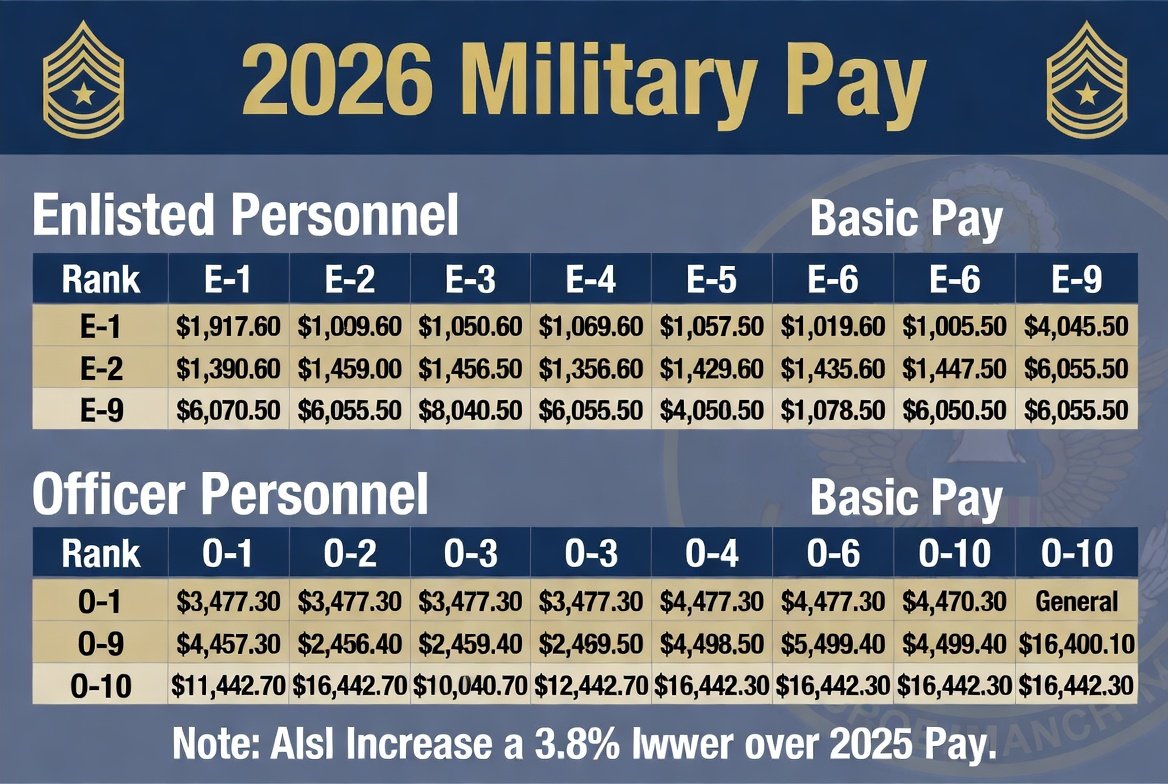
Military service members (Why this US Military Pay Chart 2026 article is important) across the United States will receive a solid 3.8% pay increase in 2026. This raise will show up in their January 2026 paychecks. The U.S. Department of Defense has approved this adjustment to help military personnel keep pace with living costs and private-sector wage growth.
This annual raise is determined using the Employment Cost Index (ECI) from the Department of Labor. Congress can sometimes adjust it, but for 2026 the standard 3.8% applies to most ranks. Note that some senior officers may get a slightly smaller raise due to legal caps tied to Executive Schedule pay levels.
US Military Pay Chart 2026: 3.8% Salary Increase – Complete Breakdown
Service members (Why this US Military Pay Chart 2026 article is important) of the American Armed Forces will receive a solid 3.8% pay raise in 2026. This increase will be effective from the first paycheck of January 2026. The main purpose of this raise is to help military personnel cope with inflation and align their salaries with the rising wages in the private sector, ultimately improving their financial well-being.
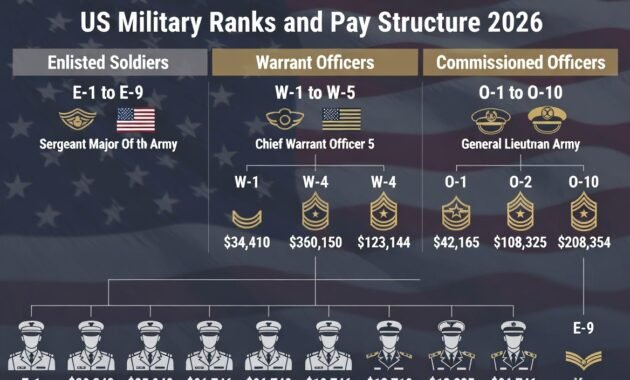
This annual pay adjustment is determined according to the Employment Cost Index (ECI). For 2026, most ranks will receive the full 3.8% increase. However, some senior officers (O-7 and above) may receive a slightly smaller raise because their salaries are subject to legal caps tied to the Executive Level pay scale.
2026 Military Basic Pay – Enlisted Ranks (Selected Highlights)
| Pay Grade | < 2 Years | Over 4 Years | Over 10 Years | Over 20 Years |
|---|---|---|---|---|
| E-9 | – | – | $7,200+ | $8,500+ |
| E-8 | – | – | $6,100+ | $7,300+ |
| E-7 | $3,850+ | $4,400+ | $5,300+ | $6,400+ |
| E-6 | $3,300+ | $3,900+ | $4,760+ | $5,600+ |
| E-5 | $2,900+ | $3,400+ | $4,100+ | $4,800+ |
| E-4 | $2,600+ | $3,000+ | $3,400+ | $3,700+ |
| E-3 | $2,300+ | $2,600+ | $2,800+ | – |
| E-2 | $2,200+ | $2,400+ | – | – |
| E-1 | $2,407 | $2,407 | – | – |
2026 Officer & Warrant Officer Pay (Monthly Basic Pay)
| Pay Grade | < 2 Years | Over 4 Years | Over 10 Years | Over 20 Years |
|---|---|---|---|---|
| O-10 | – | – | – | $18,999+ |
| O-9 | – | – | – | $18,999+ |
| O-8 | $13,888 | $14,729 | $15,882 | $18,999+ |
| O-7 | $11,540 | $12,522 | $13,639 | $16,800+ |
| O-6 | $8,751 | $10,245 | $10,783 | $13,750+ |
| O-5 | $7,295 | $8,894 | $9,928 | $12,030+ |
| O-4 | $6,294 | $7,881 | $9,420 | $10,509 |
| O-3 | $5,534 | $7,382 | $8,375 | $9,004 |
| O-1 | $4,150 | $5,222 | $5,222 | $5,222 |
| W-4 | $5,719 | $6,502 | $7,398 | $9,228+ |
| W-3 | $5,223 | $5,736 | $6,910 | $8,476+ |
| W-2 | $4,621 | $5,286 | $6,282 | $7,437+ |
Why the Military Pay Raise Matters
Basic pay is the foundation of a service member’s compensation, but it is only one part of the total package. Most military families also receive substantial tax-free allowances that significantly increase their overall take-home pay.
Key Examples of 2026 Monthly Basic Pay
Enlisted Personnel (Selected Ranks):
- E-1 (Entry level): $2,407.20
- E-5 (Sergeant / Petty Officer 2nd Class with 6+ years): ~$3,800 – $4,100
- E-6 (Staff Sergeant / Petty Officer 1st Class with 10+ years): $4,759.50
- E-7 (Sergeant First Class): $5,300+
- E-9 (Senior Enlisted Advisor): $7,200 – $8,500+
Commissioned Officers:
- O-1 (New Lieutenant / Ensign): $4,150.20
- O-3 (Captain / Lieutenant with 6+ years): ~$7,300 – $8,300
- O-4 (Major / Lieutenant Commander with 10+ years): $9,420.00
- O-6 (Colonel / Captain): $10,700 – $13,700+
- O-10 (General / Admiral): Capped at $18,999.90
Warrant Officers also fall between enlisted and commissioned pay scales, with technical experts (W-4/W-5) often earning very competitive salaries.
Who Gets This Pay Raise?
The 2026 military pay charts cover active-duty members of the Army, Navy, Air Force, Marine Corps, Coast Guard, and Space Force. Reserve and National Guard members also follow similar structures for drill pay.

Basic pay depends on two main things:
- Pay grade (rank)
- Years of service
For example:
- A fresh E-1 (lowest enlisted rank) starts at around $2,407 per month.
- An experienced E-6 with over 10 years of service earns approximately $4,760 monthly.
- New officers (O-1) begin at about $4,150 per month.
- Mid-level officers like O-4 with 10+ years can earn around $9,420 monthly.
These figures represent basic pay only. Actual take-home pay is usually much higher due to tax-free allowances.
What Else Makes Up a Military Paycheck?
Basic pay is just the foundation. Service members also receive:
- Basic Allowance for Housing (BAH) — Helps cover rent or mortgage and varies by location and family size. This is completely tax-free.
- Basic Allowance for Subsistence (BAS) — Food allowance (around $477 for enlisted and $328 for officers in 2026).
- Special and Incentive Pays — Extra money for hazardous duty, flight pay, submarine duty, language skills, deployment, etc.
- Bonuses — Signing bonuses, reenlistment bonuses, and retention incentives in high-demand fields.
Most allowances are tax-free, which significantly boosts the real value of military compensation.
How Military Ranks and Pay Work
The U.S. military uses three main categories:
- Enlisted Personnel (E-1 to E-9) — The backbone of the force.
- Warrant Officers (W-1 to W-5) — Technical specialists and experts.
- Commissioned Officers (O-1 to O-10) — Leaders and managers.
Pay increases automatically with time in service, even if you stay at the same rank. Promotions bring bigger jumps in pay.
How Military Pay is Determined
Pay depends on two main factors:
- Pay Grade (Rank: E-1 to E-9, W-1 to W-5, O-1 to O-10)
- Years of Service
Pay automatically increases with time in service, and larger jumps occur with promotions.
When and How Pay Changes
Military pay updates every January 1st. You’ll see the new rates in your first paycheck of the year. Always check your Leave and Earnings Statement (LES) on myPay.dfas.mil to verify everything is correct.
If you spot any issues with your pay, contact your finance office immediately.
Why This Raise Matters
The 3.8% increase helps military families manage inflation, rising housing costs, and other expenses. While it may not feel huge, combined with allowances and benefits like healthcare, retirement contributions (TSP), and education benefits, it forms a strong total compensation package.
Many service members say the non-cash benefits (Tricare health coverage, commissary privileges, etc.) add even more value than the base salary alone.
Previous Years Comparison
2026’s 3.8% raise is moderate compared to larger increases in recent years, but it remains consistent with efforts to keep military pay competitive.

2 comments